
Sequence of Returns Risk: The Retirement Threat That Average Returns Cannot Warn You About
"Risk comes from not knowing what you are doing."
— Warren Buffett
Meet two hypothetical families. Call them the Millers and the Garcias.
Both saved diligently for 30 years. Both retired at 65 with $1 million in their investment portfolio. Both had the same average annual return over the next 20 years, 7% per year. Both withdrew $60,000 per year to cover their living expenses.
The Millers ran out of money at age 79.
The Garcias still had $800,000 in their portfolio at 85.
Same starting balance. Same withdrawal rate. Same average return. Completely different outcomes.
The only difference was timing. The Millers retired in 2000, right before two consecutive bear markets. The Garcias retired in 2009, right at the start of a sustained bull run.
That is sequence of returns risk. It is the single most underestimated threat in retirement planning. And unlike market risk, which everyone talks about, sequence risk is almost never explained clearly until someone is already living inside it.
Why Average Returns Are Misleading
When a financial advisor shows you a 30-year average return on your investment portfolio, they are telling you the truth. They are just not telling you the whole truth.
The average return tells you what happened across all the years combined. It does not tell you which years were good and which years were bad, or when in the sequence those bad years fell. And when you are withdrawing money from a portfolio in retirement, the sequence matters as much as the average.
Here is why. In the accumulation phase, a down year is painful but recoverable. Your portfolio drops, you contribute more at lower prices, and the recovery from a down market works in your favor. The math of regular contributions into a declining market is actually beneficial over time. Financial advisors call this dollar cost averaging.
Retirement flips this relationship entirely. Instead of contributing to the portfolio, you are withdrawing from it. A market downturn in the early retirement years means you are selling shares at depressed prices to fund your living expenses. Those shares are gone permanently. When the market recovers, your portfolio participates from a smaller base. The recovery never fully offsets what the early withdrawals took out.
The sequence of annual returns, specifically whether the bad years fall early or late in retirement, determines whether your retirement portfolio lasts 30 years or 15.
The Math Nobody Shows You
Let us make this concrete.
Two portfolios. Both start at $1 million. Both generate an average annual return of 7% over 20 years. Both withdraw $60,000 per year.
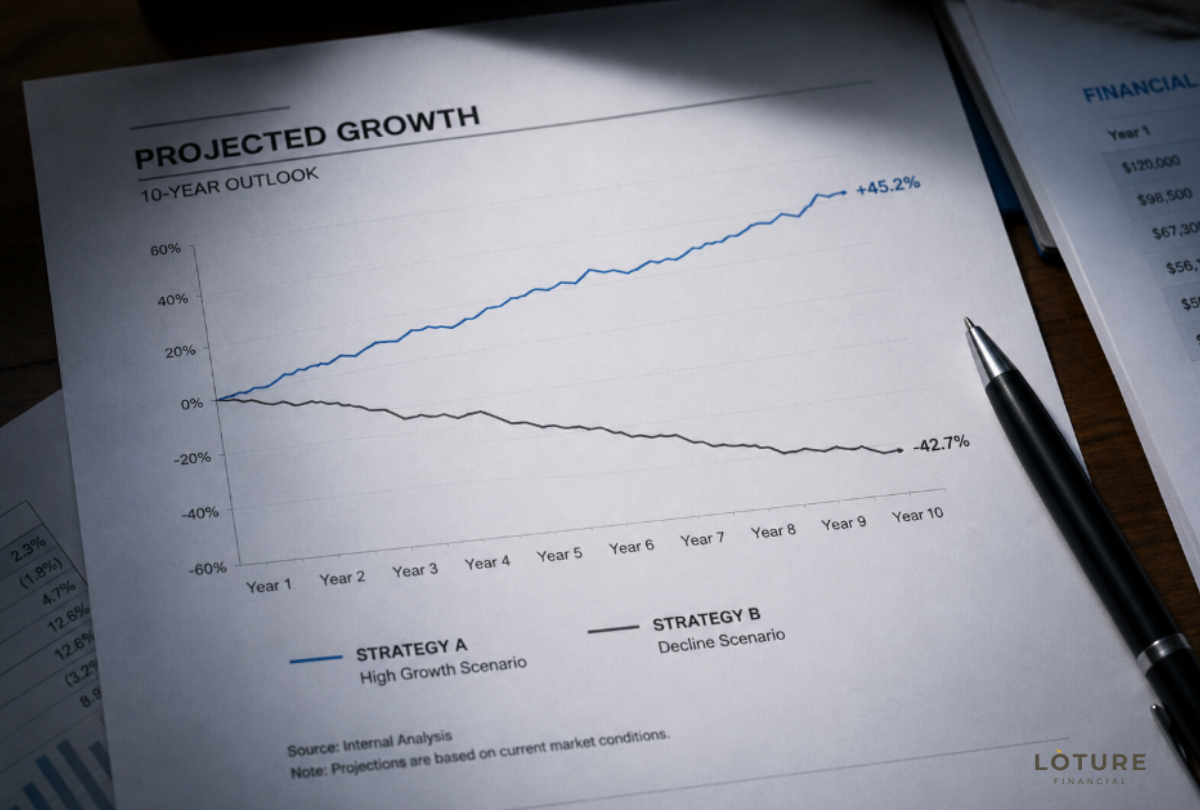
Portfolio A experiences strong returns in the first decade and negative returns in the second. Portfolio B experiences negative returns in the first decade and strong returns in the second. The sequence of annual returns is reversed between them, but the 20-year average is identical.
Portfolio A, the one with good early returns, finishes year 20 with roughly $1.2 million remaining.
Portfolio B, the one with bad early returns, runs out of money somewhere around year 15.
Same average. Same withdrawal. Twenty-year difference in outcome.
This is not a theoretical edge case. This is what happened to families who retired in 2000 versus families who retired in 2010. The dot-com crash from 2000 to 2002 and the financial crisis of 2008 were not just painful in the moment. For anyone taking withdrawals during those years, they created a structural impairment that no subsequent recovery could fully repair.
Why This Risk Is Invisible Until It Is Too Late
Sequence of returns risk does not announce itself. You cannot see it in a Monte Carlo simulation that shows your portfolio surviving 90% of historical scenarios. You cannot see it in the average return figure on your quarterly statement. It only becomes visible when you are inside it, drawing down a portfolio that started declining in the exact years you began withdrawing.
By the time most retirees understand what is happening, they have already sold shares at depressed prices for two or three years of living expenses. The damage is done and the remaining portfolio, now smaller, has to generate the same income through a recovery that may take a decade.
The practical consequence is stark. A retiree who experiences two bad market years early in retirement and responds by reducing withdrawals to $40,000 per year instead of $60,000 is effectively taking a 33% pay cut in the early years of their retirement, exactly when health, energy, and time are on their side. The families who planned for this in advance do not make that choice. The families who did not plan for it often have no alternative.
The Three Structural Defenses
Sequence of returns risk is not inevitable. It is structural. And structural problems have structural solutions.
Defense 1: Build a guaranteed income floor first.
The reason sequence of returns risk is so damaging is that it forces retirees to sell investments during a downturn to fund living expenses. The solution is to have guaranteed income that covers essential expenses without touching the investment portfolio. Social Security benefits optimized through delayed claiming provide the first layer. A fixed or fixed indexed annuity provides the second. When essential expenses are covered by income that does not depend on the investment portfolio, the portfolio can survive a multi-year market downturn without permanent damage because it is not being raided to pay for groceries.
Defense 2: Build a cash reserve buffer.
A two to three year cash reserve outside the investment portfolio serves as a withdrawal buffer during down markets. When the portfolio drops, withdrawals come from the cash reserve instead of from the depressed portfolio. This buys the investment portfolio time to recover before it is tapped, breaking the chain of selling at the worst possible prices. The buffer strategy is simple and well-documented. It requires discipline to maintain but does not require complex financial products to execute.
Defense 3: Hold assets that do not go backward.
A properly structured indexed universal life insurance policy builds cash value with a floor that prevents losses in down market years. In a year where the stock market drops 35%, the IUL policy credits zero. The cash value does not participate in the decline. Policy loans against that cash value do not require selling a depressed asset. They come out of a stable, fully valued base.
For a retiree holding both a market-exposed investment portfolio and a cash value IUL policy, a market downturn creates a simple choice: draw income from the IUL policy this year, let the portfolio recover, and return to portfolio withdrawals when the market has rebounded. The sequence risk is neutralized because the withdrawal source can be shifted away from the depressed asset at the exact moment it needs protection most.
This is not a theoretical framework. It is the structural logic behind why serious wealth architects build permanent life insurance into a complete retirement plan before retirement begins, not after sequence risk has already done its damage.
The Retirement Checklist Nobody Gave You
Before you retire, these three questions deserve honest answers.
If the market dropped 40% in your first year of retirement, where would your living expenses come from? If the answer is the portfolio, you have a sequence-of-returns risk with no defense.
What percentage of your retirement income is guaranteed regardless of market conditions? If the answer is less than your essential expenses, the gap is your exposure.
What happens to your retirement income plan if markets perform poorly for the first five years? If you have never stress-tested this scenario, you have not actually planned for retirement income. You have planned for a favorable outcome.
The families who answer these questions honestly before retirement are the ones who build the defenses while there is still time. The ones who answer them honestly after retirement are often the ones reducing withdrawals at 71 and wondering why the plan did not account for bad timing.

The Wealthy Family Blueprint shows how a complete retirement income architecture protects against sequence of returns risk, longevity risk, and the other structural threats that average returns cannot warn you about.
Get it at thewealthyfamilyblueprint.com.
─────────────────────────────────────────────────────
FAQ
What is sequence of returns risk?
Sequence of returns risk is the danger that poor investment returns early in retirement will permanently damage a retirement portfolio, even if long-term average returns remain acceptable. When withdrawals are taken from a portfolio during a market downturn, shares are sold at depressed prices and are gone permanently. The portfolio recovers from a smaller base, and the cumulative income impact can cause the portfolio to run out of money years earlier than the average return would suggest.
Why does sequence of returns risk matter more in retirement than during accumulation?
During accumulation, poor early returns are actually beneficial because regular contributions buy more shares at lower prices. In retirement, the relationship reverses. Withdrawals force selling at depressed prices. Those shares are no longer available to participate in the recovery. The earlier in retirement the bad years occur, the more severe and permanent the damage to the portfolio's ability to sustain income over a 25 to 30 year retirement.
How can you protect against sequence of returns risk?
The three primary defenses are a guaranteed income floor that covers essential expenses without touching the investment portfolio, a cash reserve buffer of two to three years of living expenses that can fund withdrawals during down markets without selling depressed investments, and assets that do not decline in down years such as a properly structured indexed universal life insurance policy whose cash value can be accessed through policy loans during poor market periods.
What is a safe withdrawal rate and how does sequence risk affect it?
The safe withdrawal rate is the percentage of a retirement portfolio that can be withdrawn annually without high risk of running out of money over a 25 to 30 year retirement. Under traditional Monte Carlo modeling the commonly cited rate is 3 to 4 percent annually. Sequence of returns risk is the primary reason the rate must be conservative. A retiree who experiences two consecutive years of significant losses early in retirement may need to reduce withdrawals well below the safe rate to preserve the portfolio, effectively taking a pay cut in the early years of retirement.
How does an IUL policy help with sequence of returns risk?
A properly structured indexed universal life insurance policy builds cash value with a floor that prevents losses in down-market years. In a year where the market drops significantly, the IUL policy credits zero rather than a negative return. The cash value remains stable. Policy loans against that stable cash value can fund living expenses during a market downturn, allowing the investment portfolio to recover without being liquidated at depressed prices. This is the structural advantage of holding a non-correlated, floor-protected asset alongside a market-exposed portfolio.
Does an annuity help with the sequence-of-returns risk?
Yes. A fixed or fixed-indexed annuity provides guaranteed lifetime income that does not depend on investment portfolio performance. When essential living expenses are covered by guaranteed annuity income, the investment portfolio does not need to be liquidated during a market downturn to fund basic needs. The portfolio can remain invested through a down cycle and recover without withdrawal pressure, directly addressing the core mechanism of sequence of returns risk.
When should you start planning for the risk of sequence of returns?
Planning should begin at least 10 years before the anticipated retirement date. The structural defenses against sequence of returns risk, including building a guaranteed income layer through annuities or delayed Social Security claiming, accumulating cash value in a permanent life insurance policy, and establishing a cash buffer reserve, all require time to build effectively. Addressing sequence risk after retirement has already begun limits the options significantly.
What is the difference between market risk and sequence of returns risk?
Market risk is the general risk that investment values will decline. Sequence of returns risk is the specific risk that the timing of those declines, particularly their occurrence early in the withdrawal phase of retirement, will permanently impair a portfolio's ability to sustain income. Two portfolios with identical long-term average returns and identical withdrawal rates can have dramatically different outcomes depending entirely on whether the poor market years fall early or late in the retirement period.